Fire Extinguisher Inspection Requirements: What Businesses Need to Know

Keeping fire extinguishers inspected, maintained, and documented is one of the most straightforward ways to protect your employees, your facility, and your business. Yet missed deadlines and sloppy records remain among the most common fire safety violations in U.S. workplaces. Here is exactly what you need to know to stay compliant.
Why Fire Extinguisher Inspection Matters for Businesses
Workplace fires rarely announce themselves with drama. Most start small: a trash can, a piece of electrical equipment shorting out, a kitchen flare-up. In the window before firefighters arrive, a portable fire extinguisher is the first line of defense. A properly maintained unit gives workers the ability to act. A failed one gives them nothing.
The numbers make the case. The U.S. Fire Administration's 2023 national estimates put nonresidential building fires at 110,000 per year, causing 130 deaths, 1,200 injuries, and roughly $3.16 billion in dollar loss. Nonresidential fires are up 19% over the past decade.
The compliance exposure is just as concrete. OSHA penalties currently run up to $16,550 per serious violation and $165,514 per willful or repeated violation. In 2023, OSHA proposed $321,419 in penalties against DG Retail LLC for a single Dollar General store in Enfield, Maine, citing carts blocking access to fire extinguishers and a failure to visually inspect extinguishers at least monthly. A missed inspection looks minor until an inspector documents the pattern.
Regulatory Overview: OSHA, NFPA 10, and Local Fire Codes
Fire extinguisher inspection and maintenance sit at the intersection of several overlapping codes.
OSHA 29 CFR 1910.157 is the federal rule governing portable fire extinguisher placement, inspection, and maintenance in general industry workplaces. The National Fire Protection Association publishes NFPA 10: Standard for Portable Fire Extinguishers, which sets the technical baseline for inspection frequencies, internal examination procedures, and testing protocols.
Many state and city fire codes adopt NFPA 10 by reference, which makes it enforceable law. The authority having jurisdiction (AHJ), meaning your local fire marshal, state agency, or insurance loss-control inspector, determines which edition applies. Verifying local requirements and meeting or exceeding them is the employer's job, not the vendor's. If you manage properties, fire extinguisher compliance is one line item inside a broader vendor compliance program that also covers insurance, licensing, and safety documentation.
Required Inspection Frequencies: Monthly, Annual, 6-Year, and Hydrostatic Testing
NFPA 10 defines four escalating service intervals:
- Monthly visual inspection. Every 30 days, performed by an in-house competent person, on all portable fire extinguishers.
- Annual maintenance. Every 12 months, performed by a certified technician, on all units.
- Internal examination. Every 6 years, performed by a certified technician, on stored-pressure dry chemical extinguishers and similar types.
- Hydrostatic testing. Every 5 or 12 years depending on extinguisher type and cylinder material, performed by a certified technician with test equipment.
Annual maintenance covers mechanical parts, the extinguishing agent, hose, nozzle, and tamper seal. At the 6-year mark, stored-pressure dry chemical extinguishers are emptied and inspected for corrosion and internal damage. Hydrostatic testing is required every 12 years for dry chemical extinguishers, while CO₂, water, and wet chemical units typically need testing every 5 years. Hydrostatic testing is also required whenever damage or repairs are evident.
Track due dates by serial number, type, and installation date. Portfolios that track by building instead of by unit are the ones that miss dates.
How to Perform and Document Monthly Fire Extinguisher Inspections
OSHA allows a trained competent person on staff to handle monthly extinguisher inspection. On every unit, confirm:
- The extinguisher is accessible and in its designated location
- Correct mounting height and visible signage
- Intact pull pin and tamper seal
- Operating instructions legible and facing outward
- Pressure gauge needle in the operable green range
- No physical damage, corrosion, leakage, or clogged nozzle
- Hose and nozzle free of obstruction
Also verify each unit is appropriate for the fire area it protects. A Class K extinguisher belongs in a commercial kitchen. An ABC dry chemical unit covers general office hazards. Travel distance to an extinguisher should not exceed 75 feet for Class A hazards or 50 feet for Class B hazards.
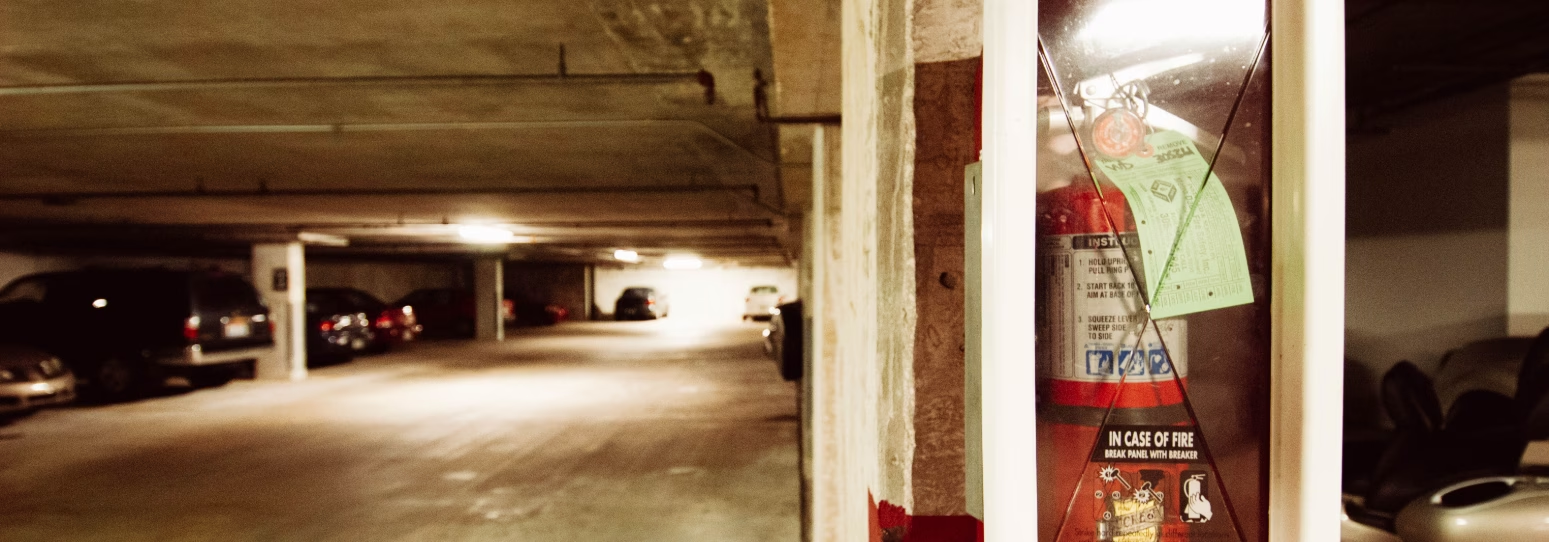
Recordkeeping is part of the inspection, not an afterthought. At minimum, capture the date of the fire extinguisher inspection, inspector name or initials, unit location, tag number, and any corrective action taken. Many businesses now use electronic inspection logs or QR-code systems to centralize records across designated places. Any missing, damaged, discharged, or overdue unit should be reported immediately and serviced or replaced.
Professional Annual Maintenance, Internal Examination, and Testing
Annual maintenance, internal examinations, and hydrostatic tests must be performed by trained, certified personnel familiar with NFPA 10 and manufacturer instructions.
During annual maintenance, a technician weighs the cylinder, inspects valves and O-rings, confirms the nozzle is unobstructed, verifies components are intact, and updates service tags. Annual maintenance records must be retained for one year after the last entry.
At 6-year intervals, technicians empty the cylinder, inspect the interior for rust, pitting, and agent deterioration, replace internal parts as needed, and recharge with approved extinguishing agent. For hydrostatic testing, the cylinder is pressurized with water to a specified test pressure, typically 150% of service pressure. Any cylinder showing leakage or permanent deformation fails and must be condemned and destroyed. Technicians then attach updated collars and labels showing month, year, service company, and technician ID.
One scheduling tip that saves real money: bundle annual maintenance with any 6-year or hydrostatic dates coming due in the same window. Fewer vendor visits, less equipment downtime.
Documentation, Labels, and Compliance Recordkeeping
For inspectors, if it is not documented, it did not happen. Employers must have a written record of inspections, maintenance, and testing. Records of inspections must be maintained for at least 12 months, and many insurers expect three to five years of history.
Core record types include:
- Monthly inspection tags or digital logs
- Annual maintenance service tags
- Internal examination verification collars (minimum 2 x 3 inches, weatherproof)
- Hydrostatic test labels with date and technician ID
Each tag should include the business name, service company, unique extinguisher ID, type and size, date of service, kind of service performed, and technician signature. Maintain a centralized inventory mapping each unit to its installed location by floor, room, or zone, with last and next due dates visible. Healthcare, education, and other high-risk industries may need more detailed logs for Joint Commission or state health department audits.
Staying Compliant Across Locations: Practical Tips for Businesses
Multi-site businesses juggling hundreds of portable fire extinguishers across different jurisdictions face a real coordination problem. Different states enforce different editions of NFPA 10, and local amendments can tighten schedules further.
Practical steps to stay ahead:
- Assign a designated fire safety coordinator who owns inspection schedules and vendor relationships
- Standardize extinguisher types where possible, such as ABC 5-lb units in offices and larger wheeled extinguishers in warehouses, to simplify spare-parts inventory
- Implement a digital tracking system that triggers alerts before monthly inspections, annual maintenance, or hydrostatic tests come due
- Build fire extinguisher inspection training into onboarding for maintenance and safety teams, including how to read gauges and identify hazards
- Fold extinguisher inspection into your broader vendor safety program rather than running it as a standalone task
- Partner with fire protection service providers who carry current, verified certifications
That last point is where most portfolios lose time. Certificates of insurance expire, technician licenses lapse, and nobody notices until an inspector asks. Certificate of insurance tracking that runs on spreadsheets tends to fail quietly. Centralizing vendor credentials alongside your service records means the paperwork is ready before the fire marshal arrives, not scrambled together after.
Consistent inspection reduces risk, helps you pass unannounced fire marshal visits, and builds a culture of fire prevention across every building in your portfolio.